Jersey Supply Chain AI
Real-Time AI Risk Intelligence for a Nation's Supply Chain
3-Model Ensemble
Model architecture
9,573
Training rows
30 Days
Forecast horizon
12 Weeks
Timeline
Who this was for
Jersey Island government, specifically the supply chain governance team responsible for monitoring food, fuel, medicine, and general goods import resilience. End users include policy analysts and senior officials who are not data scientists but need to act on model outputs.
The Problem
Jersey Island is a small island economy with acute exposure to import disruption. Food, fuel, medicine, and general goods all arrive via a limited set of shipping routes, and any disruption (weather, geopolitical events, port congestion) can cascade into shortages within days.
The government's existing monitoring was reactive — spreadsheets updated weekly, no forecasting capability, and no way to simulate "what if" scenarios. They needed a real-time risk intelligence layer with predictive forecasting and scenario simulation.
Constraints
Government data could not leave Jersey Island infrastructure, the entire inference stack had to be internally deployable.
Historical training data was limited and required heavy preprocessing to produce clean time-series inputs.
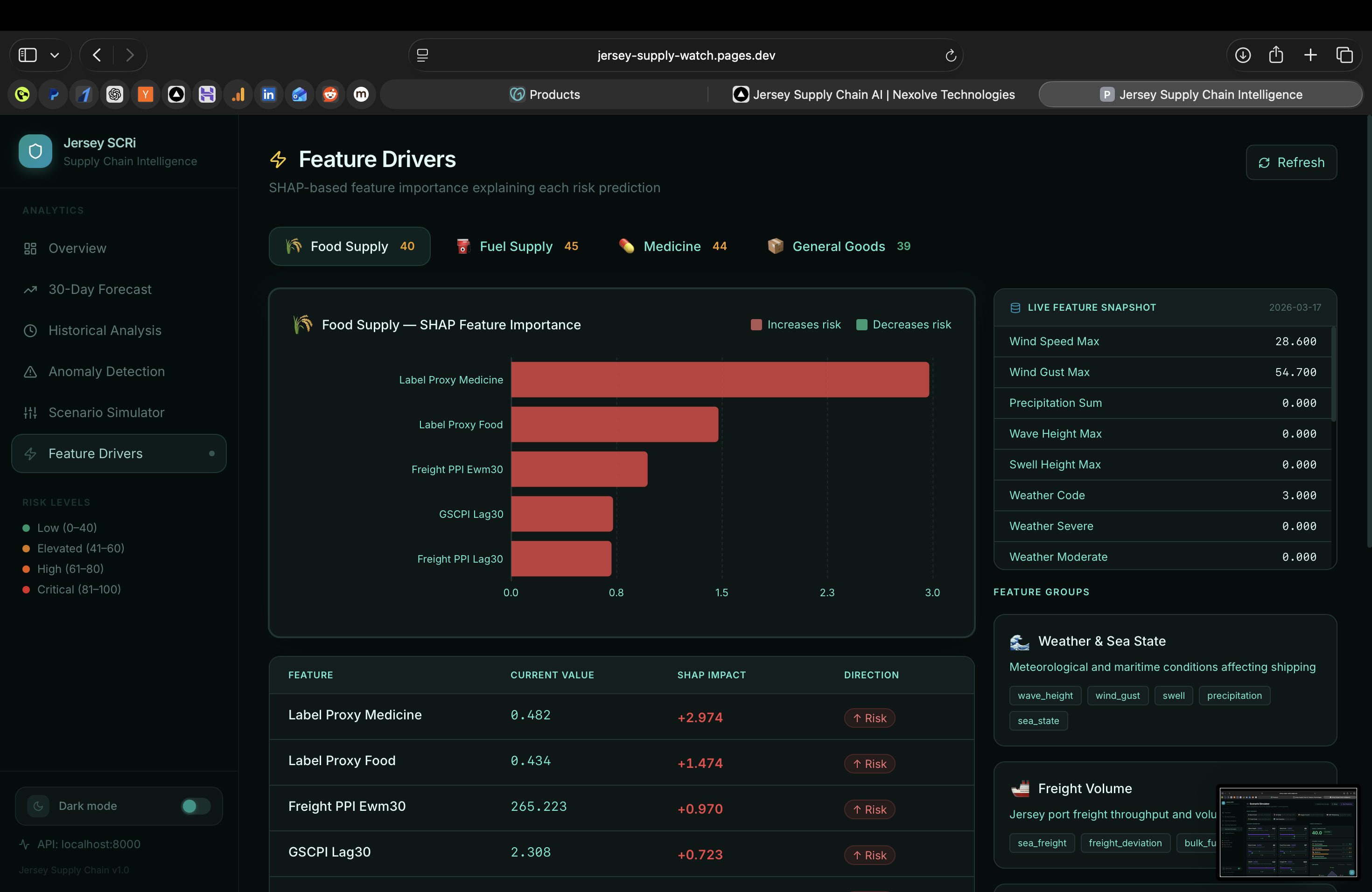
Dashboard outputs had to be interpretable by non-technical policy analysts, XGBoost feature importance was a hard requirement, not a nice-to-have.
Scenario simulation had to run in real time, re-spawning model training per scenario was not viable.
Severity scoring (1–5) had to be calibrated to actual supply chain risk thresholds, not arbitrary statistical percentiles.
How Nexolve Built It
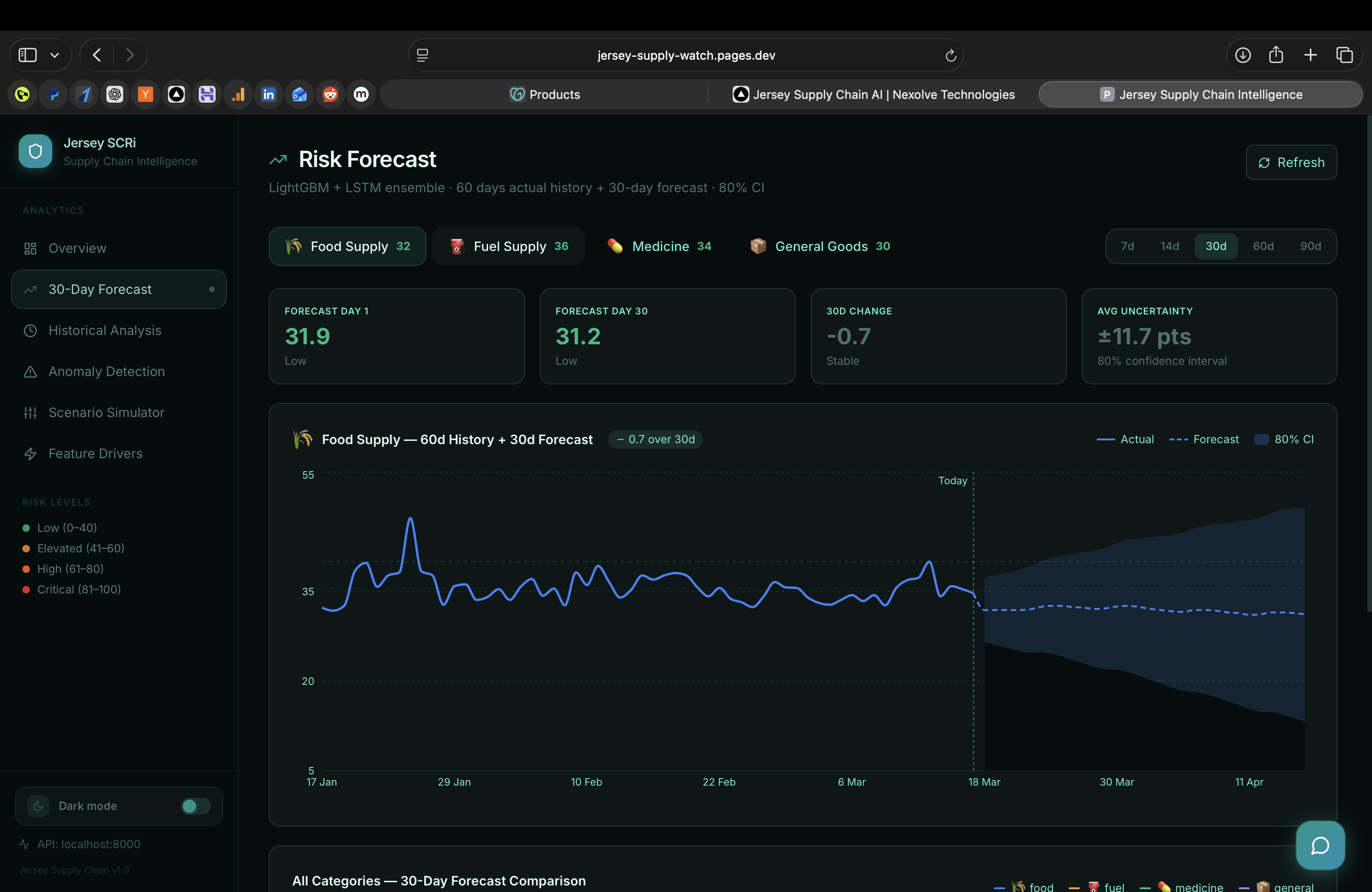
A 3-model ML ensemble, LSTM for temporal patterns, XGBoost for interpretable feature importance, and isolation forest for anomaly detection, trained on years of supply chain history and served via a FastAPI backend with a Next.js decision-support dashboard.
- 1
LSTM for temporal dependencies
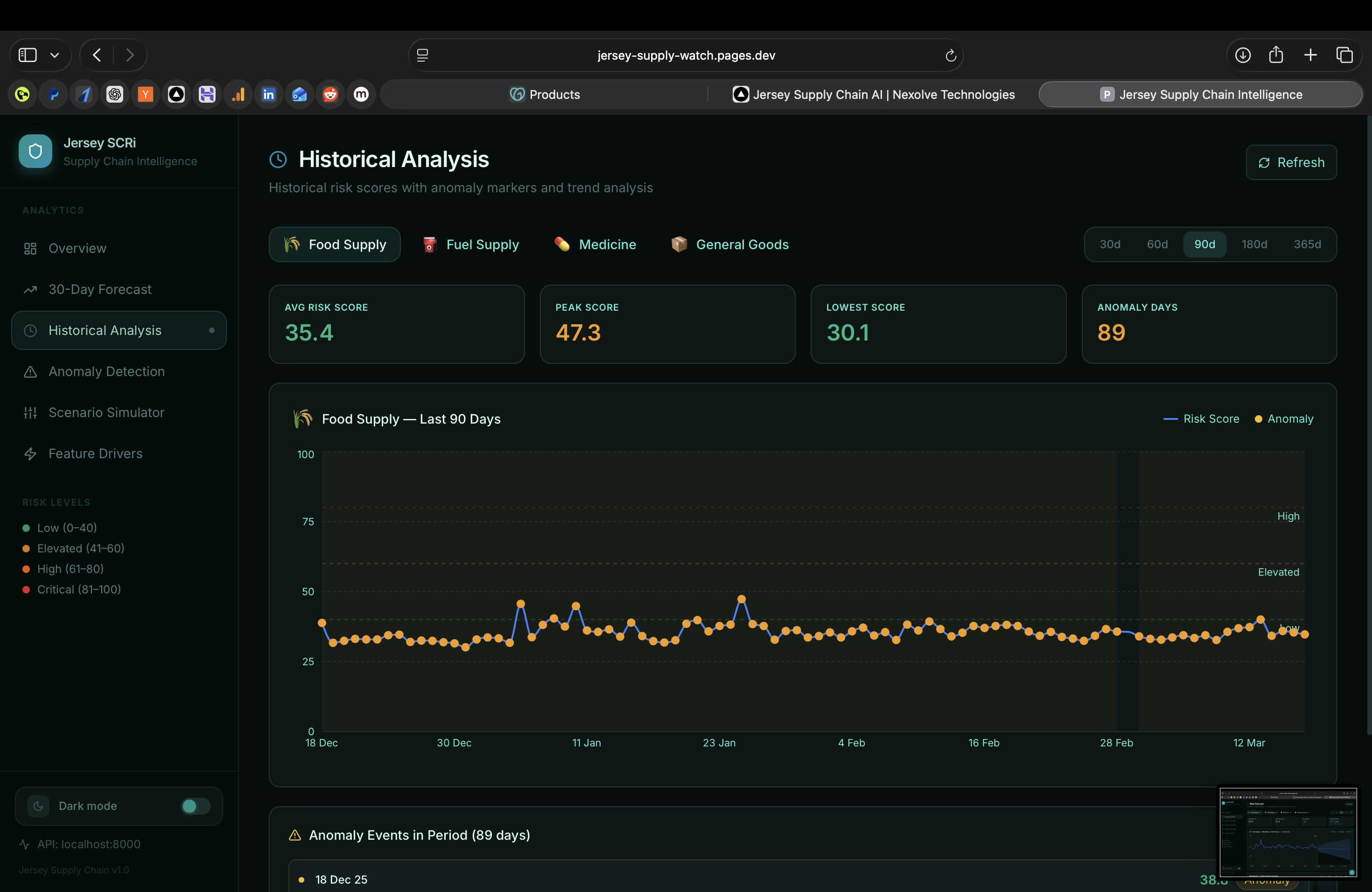
Long Short-Term Memory network captures seasonal cycles and temporal dependencies in historical import volumes. Trained on 9,573 rows of supply chain history across food, fuel, medicine, and general goods categories.
- 2
XGBoost for feature importance
Gradient-boosted decision trees provide interpretable feature importance rankings per supply category, letting analysts understand which variables (weather, geopolitical events, shipping routes) drive risk scores.
- 3
Isolation forest for anomaly detection
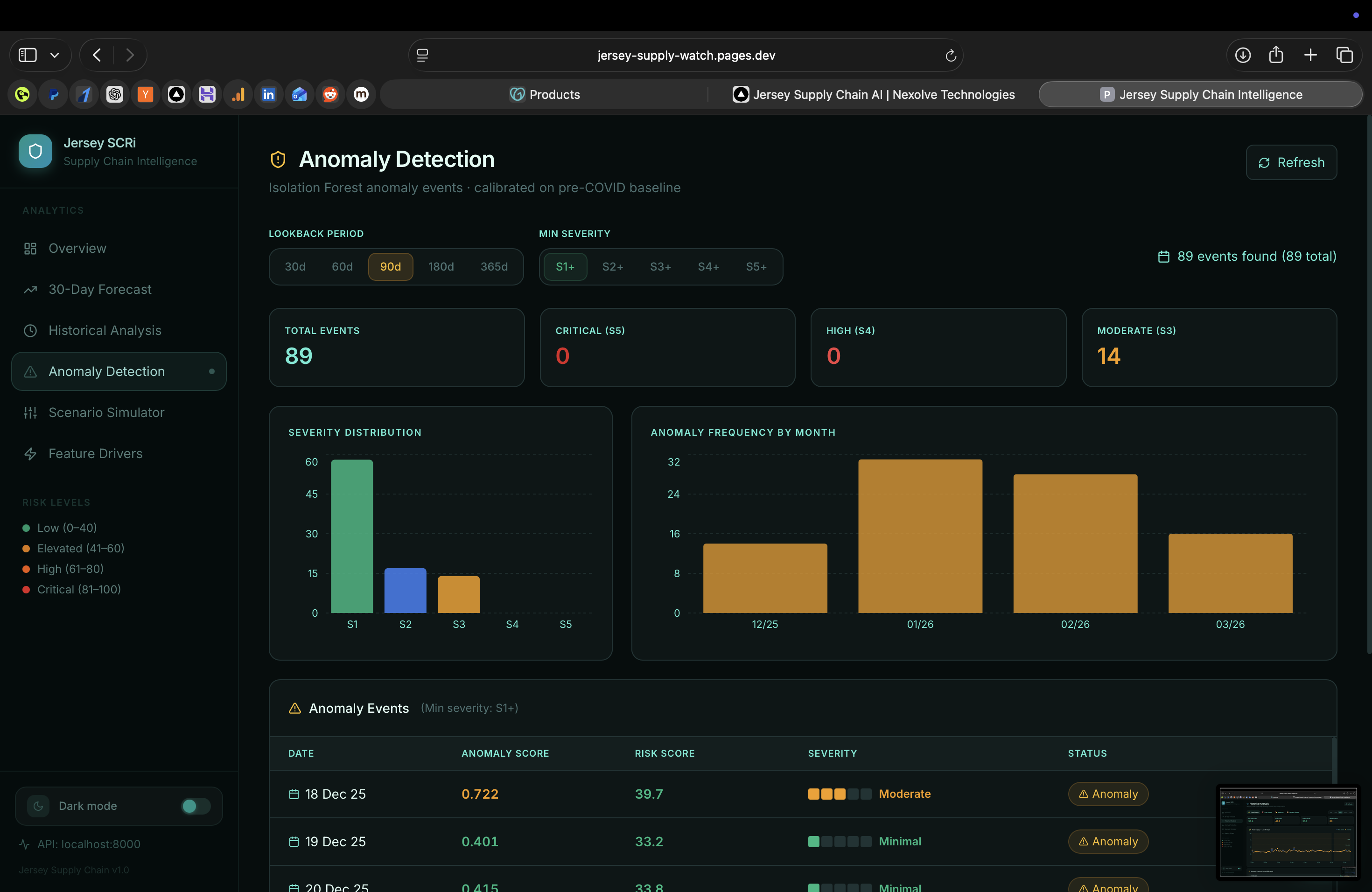
Statistical outlier detection flags supply chain disruptions with severity scores (1–5). The isolation forest runs independently and triggers alerts when import patterns deviate beyond configurable thresholds.
- 4
FastAPI inference backend
PKL-serialised trained models are hosted on HuggingFace and loaded by a FastAPI Python backend on startup. The inference endpoint returns live risk scores, category breakdowns, and 30-day forecasts in under 200ms.
- 5
Scenario simulation engine
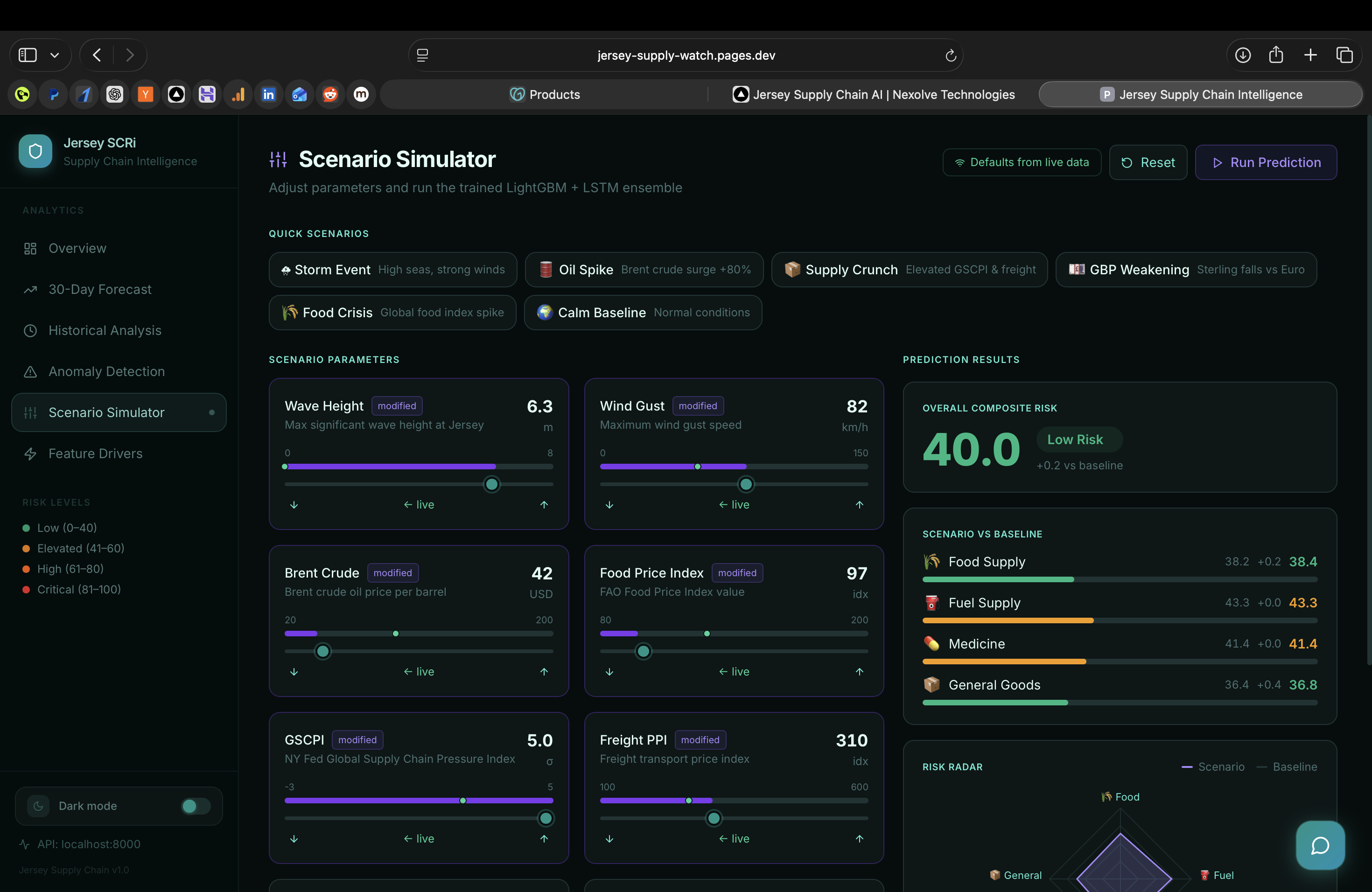
Analysts can stress-test hypotheticals, 'What if fuel imports drop 30% for 2 weeks?', and the ensemble re-runs forecast projections in real time, showing cascading effects across dependent supply categories.
Tech Stack
Outcomes
Real-time risk scores across food, fuel, medicine, and general goods, updated continuously.
30-day forecasting horizon lets analysts prepare for disruptions before they materialize.
Scenario Simulator enables stress-testing hypotheticals with cascading effect analysis.
Interpretable feature importance via XGBoost, analysts understand why risk scores change, not just that they changed.
Anomaly detection catches statistical outliers with severity grading (1–5) for prioritised response.
Need AI-powered forecasting for your operations?
We build custom ML pipelines from data to deployed dashboard. Book a free 20-minute call and let's scope your use case.