Rust / Substrate
Runtime
AES-256-GCM
Encryption
$9.99/mo
Starting Price
About the Project
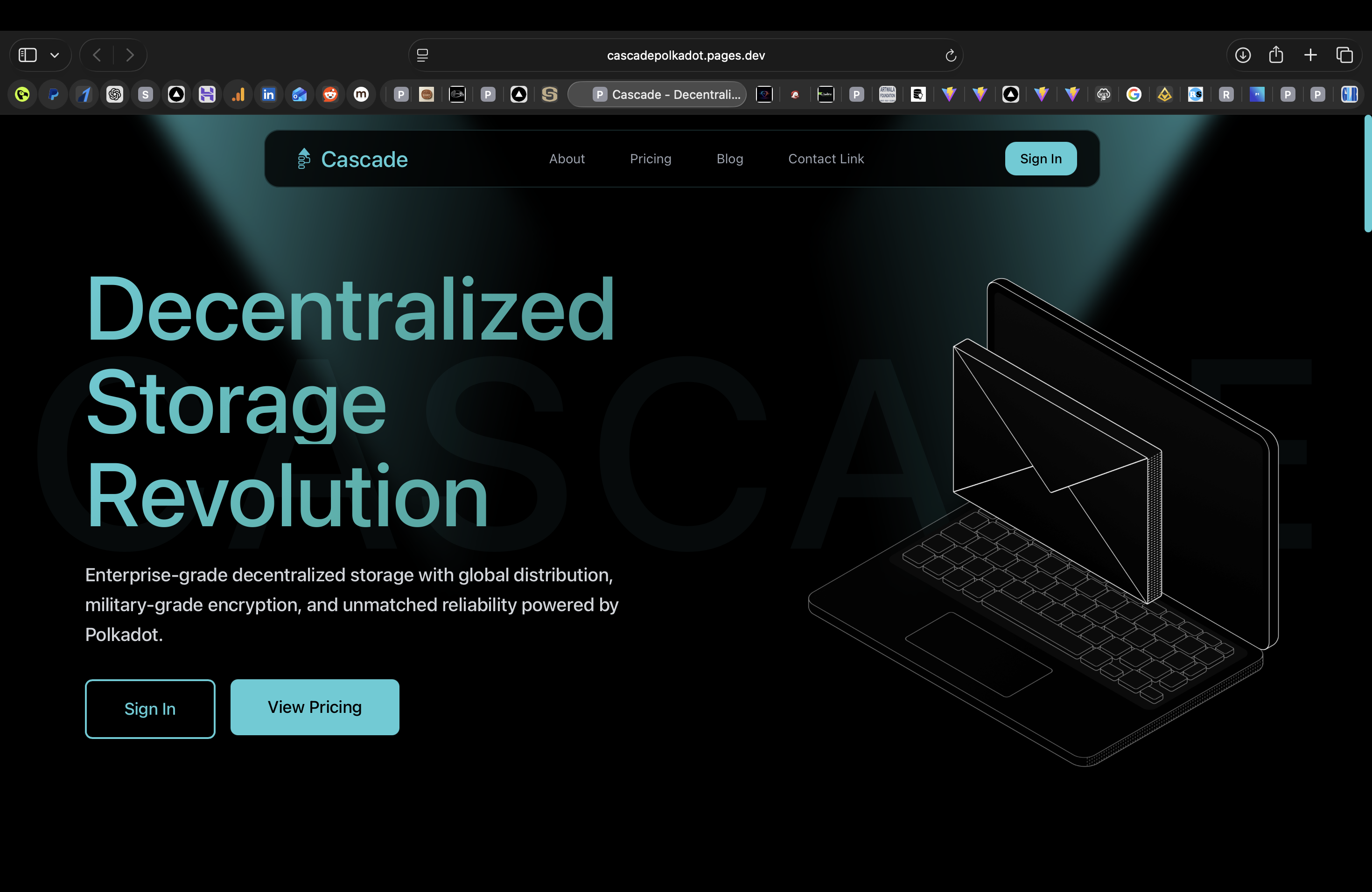
Cascade is a trustless, censorship-resistant storage network built on Polkadot's shared-security relay chain. The runtime logic and storage pallets are written in Rust using Substrate, with a Next.js frontend and Supabase handling user auth and session metadata. Files are sharded, encrypted client-side with AES-256-GCM before ever leaving the browser, and distributed across geo-redundant Substrate-powered storage nodes. Cross-chain messages via XCM let any Polkadot parachain read and write to the network without bridging risk.
How It Works
- 1
The Next.js frontend connects via WalletConnect, users authenticate with a Polkadot-compatible wallet; Supabase stores session-scoped metadata with row-level security.
- 2
The client SDK splits files into fixed-size chunks and derives a unique encryption key per chunk using HKDF over the user's root secret, encrypting each with AES-256-GCM before upload.
- 3
Each chunk is pushed to the IPFS DHT, producing a content identifier (CID) that doubles as an integrity hash; the Rust-based Substrate pallet records CID ↔ node mappings on-chain.
- 4
The reputation engine scores nodes by latency, uptime, and Proof-of-Space-Time challenge pass-rate, routing retrieval requests to the highest-scoring node subset.
- 5
XCM messages allow any Polkadot parachain to invoke storage operations natively, no trusted bridge, no wrapped token, no centralised relay required.
Tech Stack
Want to build something like this?
We'd love to hear about your project. Let's talk about what you're building.