Paranode
Unified On-Chain Karma Oracle, Reputation Across Every Social Layer
View Live Project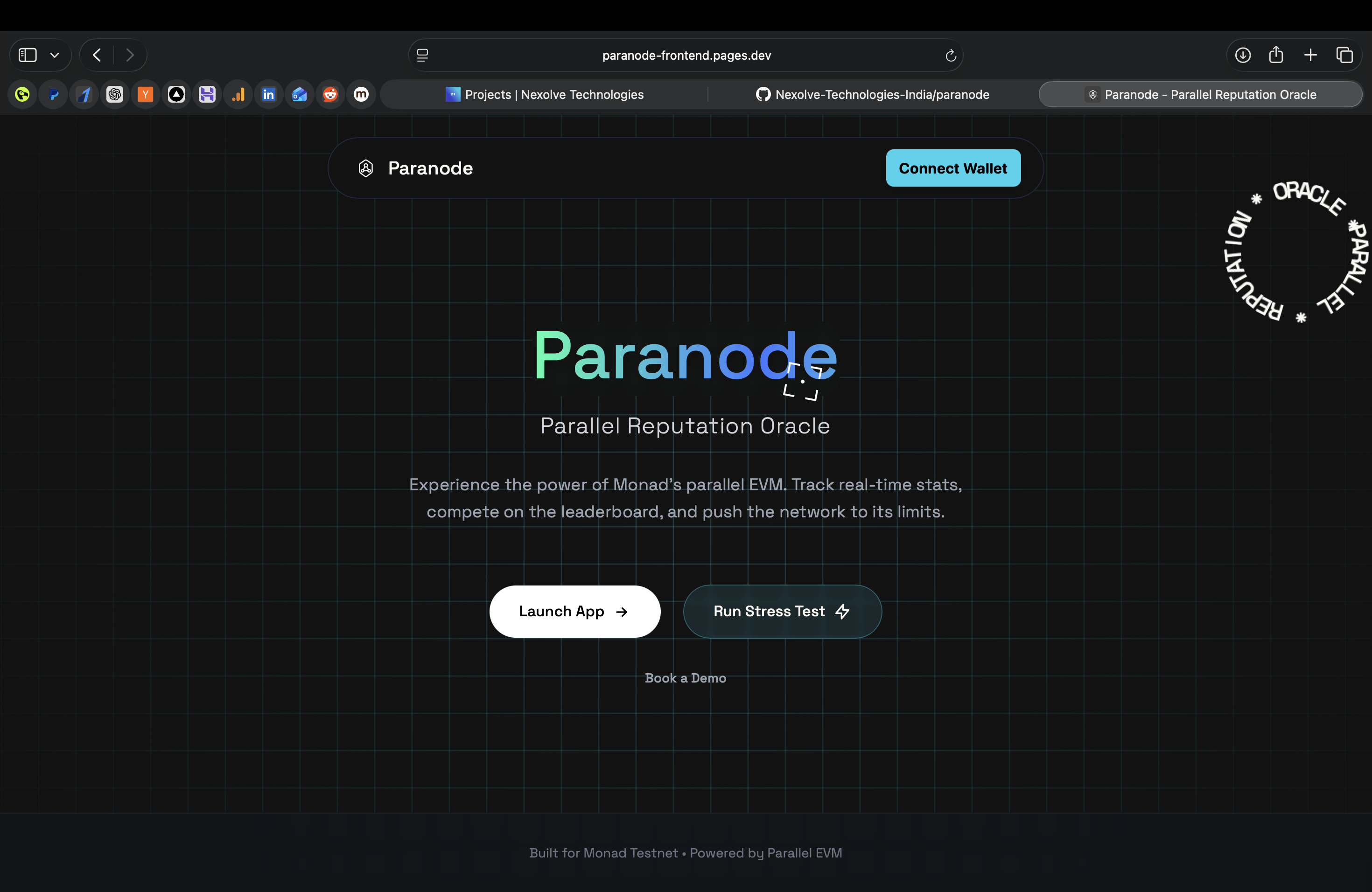
Monad (Parallel EVM)
Blockchain
Twitter, GitHub, Farcaster, Lens, Discord
Data Sources
On-chain, trustless
Oracle Model
About the Project
Paranode is a high-throughput on-chain reputation oracle built on Monad's parallel EVM, the first blockchain capable of executing thousands of EVM transactions in parallel without sacrificing composability. It aggregates social signals from Twitter/X, GitHub, Farcaster, Lens Protocol, and Discord into a single unified Karma Score that is written on-chain via a Solidity oracle contract, creating a portable, tamper-proof reputation primitive any dApp can query. The Next.js TypeScript frontend uses WalletConnect for wallet-based authentication and Shadcn UI for the analytics dashboard; Supabase stores aggregated off-chain signal metadata and leaderboard state. Paranode also functions as a network stress-testing tool, its high-frequency reputation update writes push Monad's parallel execution engine to its throughput limits in real time.
How It Works
- 1
Users connect their Web3 wallet via WalletConnect and link their social accounts (Twitter/X, GitHub, Farcaster, Lens, Discord); Supabase stores OAuth tokens under row-level security and begins aggregating activity signals per account.
- 2
An off-chain aggregation service scores each social signal, GitHub commits, PR reviews, protocol interactions, post engagement, governance votes, applying platform-specific weighting coefficients to produce a normalised Karma Score.
- 3
The aggregated Karma Score is committed on-chain via a Solidity oracle contract deployed on Monad Testnet; Monad's parallel EVM processes thousands of simultaneous reputation update transactions in a single block without serialisation bottlenecks.
- 4
Any dApp on Monad can call the oracle contract's `getKarma(address)` function to trustlessly read a user's verified reputation score, enabling karma-gated access, reputation-weighted voting, and dynamic NFT traits without off-chain dependencies.
- 5
The leaderboard and stress-test dashboard are served by the Next.js frontend querying Supabase for aggregated stats and the Monad RPC for live chain metrics, surfacing TPS, parallel execution efficiency, and per-wallet karma rankings in real time.
Tech Stack
Want to build something like this?
We'd love to hear about your project. Let's talk about what you're building.